Fridges, freezers & ice makers
Refrigerator Repair in Sunnyvale, CA
The milk is warm, the freezer is caked with frost, or there’s water under the crisper drawers. Here’s what usually causes refrigerator problems, what you can safely check, and when to call a technician.
Free referral to a local appliance repair company. No obligation to hire.

What Refrigerator Repair Covers
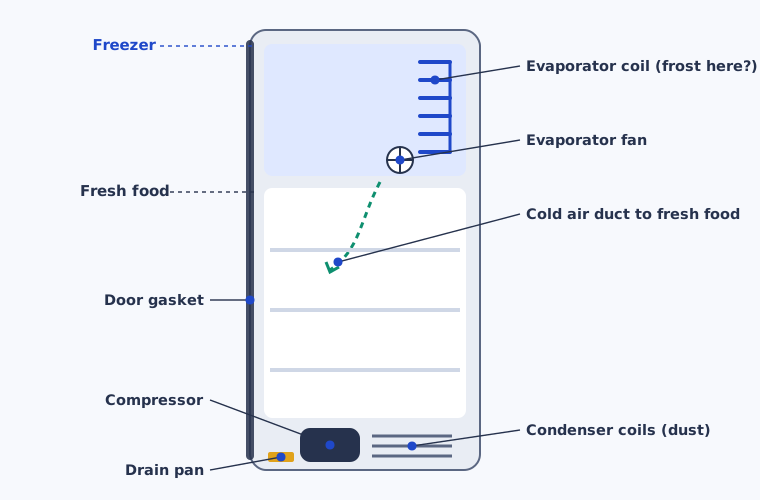
Refrigerator repair in Sunnyvale, CA means diagnosing and fixing the parts that keep food cold: evaporator and condenser fans, defrost heaters, thermostats and temperature sensors, door gaskets, water inlet valves, ice makers and dispensers, control boards and, when needed, the sealed refrigerant system. Most calls are about a fridge that isn’t cooling, a freezer that frosts over, a leak or a new noise.
Refrigerators run around the clock, so small parts wear out long before the cabinet does. A fan motor that has turned for ten years, a defrost heater that has cycled thousands of times, or a gasket that has been opened and closed by a busy family every day are typical failures, and all of them are repairable. A good technician tests before replacing anything, so you pay for the part that actually failed. For an overview of every appliance we cover, see appliance repair in Sunnyvale, CA.
Signs Your Refrigerator Needs Service
- Fresh-food section above 40°F while the freezer still feels cold.
- Frost or ice building up on the back wall of the freezer, or a frozen drain at the bottom.
- Water on the floor or pooling under the crisper drawers.
- Clicking, buzzing or grinding from the back or bottom, or a fan that rattles.
- Runs constantly and the outside feels unusually warm.
- Ice maker stopped, makes small or hollow cubes, or the dispenser drips.
- Food freezing in the fresh-food section.
- Error code or flashing lights on the control panel that come back after a reset.
What You Can Safely Check First
Before you book a visit, a few quick checks solve a surprising number of calls:
- Check the thermostat settings. They get bumped when the fridge is loaded. Fresh food should be at 37–40°F and the freezer at 0°F.
- Make sure the vents aren’t blocked. A box or bag pushed against the vent inside the fresh-food section can cut off the cold air.
- Look at the door gasket. Close a dollar bill in the door; if it slides out easily, the seal may be weak or the door out of level.
- Clean the condenser coils. Unplug the fridge, remove the toe grille and vacuum the coils and the fan area.
- Listen for the fans. Open the freezer and press the door switch; you should hear the evaporator fan run.
Move what you can to a cooler with ice and keep the doors shut. If the fridge has been above 40°F for more than two hours, perishable food like meat, dairy and leftovers should be thrown out.
Common Causes Technicians Find
| Problem | Common cause | Typical fix |
|---|---|---|
| Fridge warm, freezer cold | Failed evaporator fan or iced-over coil from a defrost fault | Replace fan motor or defrost heater, thermostat or control |
| Both sections warm | Condenser fan, start relay, dirty coils or a compressor issue | Clean coils; replace fan or relay; test the sealed system |
| Water under crisper drawers | Clogged defrost drain line | Clear and flush the drain; fix the defrost fault if present |
| Water on the floor | Leaking inlet valve, water line or cracked drain pan | Replace the valve, line or pan |
| Ice maker not working | Water inlet valve, frozen fill tube or a failed ice maker | Replace the valve or ice maker; thaw the fill tube |
| Loud clicking every few minutes | Start relay or overload trying to start the compressor | Replace the relay; test the compressor |
Sealed-system repairs, such as a refrigerant leak or a failed compressor, are the most expensive and require an EPA-certified technician. On a standard refrigerator more than about ten years old, that’s the point where many owners choose to replace instead.
French-Door, Side-by-Side, Built-In and Mini Fridges
Different designs fail in different ways. French-door and bottom-freezer models have long air paths and often a separate fan for the fresh-food section, so airflow problems are common. Side-by-side refrigerators put the ice maker and dispenser in the freezer door, and leaks or ice jams there are a frequent call. Counter-depth and built-in refrigerators pack the condenser into a tight space at the top or bottom; keeping those coils clean matters even more.
Newer models increasingly use variable-speed inverter compressors and electronic controls instead of mechanical thermostats. They’re quieter and more efficient, but diagnosing them takes the right tools and service information. If you have a panel-ready or 36- to 48-inch built-in model, see our page on high-end appliance repair. If the freezer is fine and only the dishwasher next to it is leaking, read about dishwasher repair.
Second Fridges, Garages and Heat Waves
Plenty of Sunnyvale households keep a second refrigerator or a chest freezer in the garage. Garages get hot in a late-summer heat wave and cooler than the kitchen in winter, and many standard refrigerators aren’t designed for those swings. A garage fridge that stops cooling in August, or lets the freezer thaw on a cold night, may be working exactly as designed for the wrong room. Some models are built for garage use; a technician can tell you whether yours is.
Heat is also when weak parts finally give out. A condenser fan that was barely keeping up in spring may fail when the kitchen is 85°F. Cleaning the coils before summer and leaving a few inches of space behind and above the refrigerator helps it get rid of heat. If a power outage is the cause, keep the doors closed and wait; most refrigerators restart on their own when power returns.
Repair Costs, Timing and the Food Clock
Refrigerator calls are the ones where timing matters most, because the food is on a clock from the moment the cooling stops. When you call, say that the refrigerator isn’t cooling and roughly how warm it is; many companies try to prioritize those calls. While you wait, keep the doors shut, group the most perishable food together, and use a cooler with ice for milk, meat and medication that needs refrigeration.
On the cost side, fans, start relays, thermostats, defrost heaters and door gaskets are the most common repairs, and most are completed in one visit if the technician carries the part. Control boards and ice maker assemblies are pricier and sometimes need to be ordered. Sealed-system repairs, such as a leak in the refrigerant lines or a failed compressor, take the longest and cost the most; that’s where the age of the refrigerator decides whether to repair. Ask for the price in writing before the work starts, which California’s rules for registered repair dealers require.
One more tip: write down the model and serial number from the sticker inside the fresh-food section before the technician arrives. It lets them check part availability and service bulletins ahead of time, which often turns a two-visit job into one.
FAQ
Refrigerator Repair Questions
How much does refrigerator repair cost in Sunnyvale?
It depends on the part. Fans, relays, thermostats and gaskets are usually moderate repairs; control boards and sealed-system work cost more. A technician gives you a price after testing, and many companies credit the diagnostic fee toward the repair.
Why is there water under my crisper drawers?
Usually a clogged defrost drain. Frost melts off the coil during defrost and runs down a small drain to a pan under the fridge. When the drain freezes or clogs, water backs up into the fresh-food section.
Should I unplug my fridge if it stops cooling?
Not unless you see smoke, smell burning or a technician asks you to. Unplugging it for a few hours can melt an iced-over coil temporarily, but the problem will return until the cause is fixed.
Is it normal for a refrigerator to make noise?
Humming, gentle clicking and the sound of water during defrost are normal. Loud grinding, rattling, repeated clicking every few minutes or a fan that squeals are not; they often point to a fan motor or start relay.
Can you fix my ice maker?
Usually. The common causes are a failed water inlet valve, a frozen fill tube, a clogged filter or a worn-out ice maker assembly. Mention it when you call so the technician can bring the likely parts.
How long should a refrigerator last?
Roughly 10 to 15 years for most standard models, and longer for built-in models that are maintained. Clean coils and a good door seal help it last.
Free call, local technicians
Fridge not cooling? Talk to a local appliance tech.
One free call connects you with an independent appliance repair company that services refrigerators in Sunnyvale and nearby cities.