Refrigerator Repair
Warm fridge, frozen-over freezer, leaks, ice maker and water dispenser problems.
Sunnyvale, Santa Clara, Mountain View, Cupertino & San Jose
One free call connects you with an independent appliance repair company that serves your part of Silicon Valley. A local technician finds the fault, explains the fix and gives you a price before any work starts.
Sunnyvale Appliance Pros is a referral service, not an appliance repair company. How it works.

Appliance repair in Sunnyvale, CA covers the machines a household can’t do without: refrigerators and freezers that stop cooling, washers that won’t drain or spin, dryers that tumble but don’t heat, dishwashers that leak or leave dishes dirty, and ovens, ranges and cooktops that won’t light or hold temperature. A technician tests the parts, finds the one that failed and replaces it, which usually costs far less than buying new.
Sunnyvale sits in the middle of Silicon Valley, between Mountain View and Santa Clara, and its housing tells the story of the valley’s growth. Orchards became subdivisions in the 1950s and 1960s, and many of those single-story ranch homes and mid-century tracts, including the city’s well-known Eichler neighborhoods, still stand. Since then the city has added townhomes, condos and large apartment communities, and a big share of households rent. That mix means appliances of every age, from a twenty-year-old wall oven sized to an original cutout to a brand-new smart refrigerator with a Wi-Fi board.
Most appliance problems come down to a short list of parts: a fan motor, a heating element, a thermostat or sensor, a pump, a valve, a belt, a door switch or a control board. Water is behind a lot of failures. Mineral scale builds up in valves, ice makers and dishwasher spray arms, and a small leak can warp flooring or soak into a cabinet before anyone notices. Heavy use matters too: families who work from home run the dishwasher and laundry more often than they used to. Call a technician when an appliance stops doing its job, trips a breaker, leaks, smells hot, makes a new grinding or banging noise, or shows an error code that comes back after a reset.

01 / Pick your appliance
Each appliance has its own guide: what usually fails, what you can check first and when to call.
Warm fridge, frozen-over freezer, leaks, ice maker and water dispenser problems.
Front-load and top-load washers that won’t drain, spin, fill or stop leaking.
Electric and gas dryers that don’t heat, take forever, squeal or won’t start.
Dishwashers that leak, won’t drain, leave dishes dirty or show error codes.
Gas and electric ranges, wall ovens and cooktops, including induction.
Built-in refrigerators, pro-style ranges and premium kitchen suites.
02 / Appliance checker
Most breakdowns give a warning first. Match what you see to the likely cause.
Tap everything you’ve noticed and the checker points you to the guide that fits best. It’s a starting point, not a diagnosis. If you smell gas, don’t touch switches or the range: leave the house and call PG&E or 911 from outside.
| What you notice | What it often means | Where to start |
|---|---|---|
| Fridge warm, freezer cold | Evaporator fan or defrost problem, or a blocked air duct | Refrigerator repair |
| Washer stops with water inside | Clogged pump filter, a sock in the drain hose or a failed drain pump | Washer repair |
| Dryer runs but stays cool | Heating element, thermal fuse or gas igniter, often after a clogged vent | Dryer repair |
| Puddle in front of the dishwasher | Door gasket, a cracked hose or a leaking pump seal | Dishwasher repair |
| Oven slow to heat or never reaches temp | Weak igniter (gas) or a failed bake element or sensor (electric) | Oven and stove repair |
| Error code that keeps coming back | A sensor, a door switch or the control board | Call with the code and model number |
03 / The in-depth guide
Five parts do almost all the work. Knowing them makes any technician’s diagnosis easier to follow.
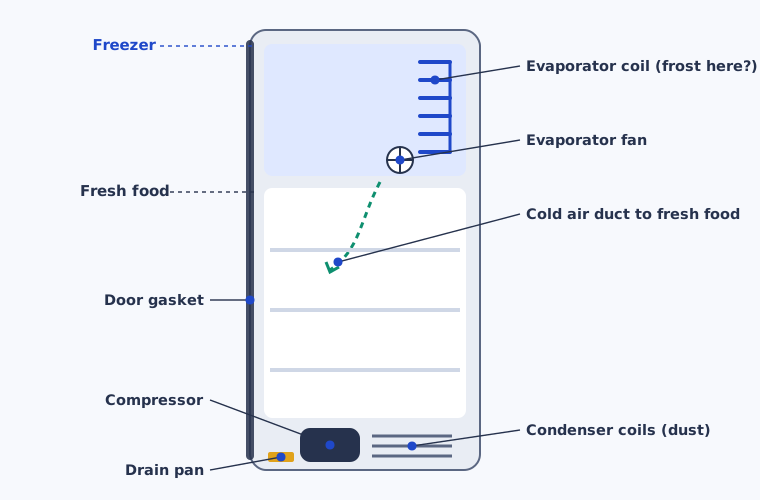
Most modern refrigerators make all their cold in one place: an evaporator coil hidden behind the back wall of the freezer. A small evaporator fan pushes that cold air into the freezer and through a duct into the fresh-food section. Down at the bottom, the compressor pumps refrigerant and the condenser coils and a second fan get rid of the heat. A few times a day a defrost heater melts frost off the coil and the water runs to a drain pan to evaporate.
That’s why the most common complaint, “the freezer is fine but the fridge is warm,” so often points to the fan, the defrost system or a duct packed with ice rather than the compressor. It’s also why dusty condenser coils and a torn door gasket make a refrigerator run longer and cost more to operate. Our refrigerator repair guide walks through each symptom.
Keep the doors closed. A closed refrigerator keeps food safe for about four hours without power; a full freezer holds for about 48 hours and a half-full one for about 24. Food in the fridge should stay at 40°F or below.
04 / Repair or replace
The 50% rule, and the exceptions that matter in Silicon Valley kitchens.
The question every caller asks is whether a repair is worth it. A common rule of thumb: if the appliance is past about half its expected life and the repair costs more than about half the price of a comparable new one, replacing it usually makes more sense. Below that line, repair almost always wins, and it keeps a working machine out of the landfill.
A few things change the math. Built-in and premium appliances cost far more to replace and are designed to be serviced, so repair is worth it for much longer. A refrigerator with a sealed-system failure (a refrigerant leak or a dead compressor) is a bigger repair than one with a bad fan. And in a kitchen remodeled around a specific wall oven or cooktop, a new unit that doesn’t fit the cutout can mean cabinet work on top of the appliance cost.
A good technician tells you what failed, what the part and labor cost, and roughly how much life the appliance has left, then lets you decide. You’re never obligated to approve a repair.
| Appliance | Typical life | Usually worth repairing |
|---|---|---|
| Refrigerator | 10–15 years | Fans, thermostats, defrost parts, valves, ice makers |
| Washer | 10–13 years | Pumps, lid and door locks, belts, valves |
| Dryer | 10–15 years | Elements, igniters, belts, rollers, thermal fuses |
| Dishwasher | 9–12 years | Pumps, inlet valves, door gaskets, latches |
| Range or oven | 13–18 years | Igniters, bake elements, sensors, burner switches |
Ranges vary by brand, model and how hard the appliance is used.
05 / Local know-how
The homes, the people and the push toward all-electric kitchens all shape the work.
A large share of Sunnyvale households rent. If your landlord supplied the appliance, it’s usually theirs to repair, so check your lease and let them know first. Property managers and owners of rentals call for fast turnarounds between tenants.
Ranch homes and Eichler tracts from the 1950s and 1960s often have built-in wall ovens and cooktops set into original cutouts. Repairing them, or finding a replacement that fits, takes a technician who knows older built-ins.
Bay Area homes are switching from gas to induction cooktops and heat pump dryers and water heaters. These appliances have their own electronics and failure points, and a tech who works on them regularly diagnoses them faster.
Remodeled kitchens across Silicon Valley feature built-in, panel-ready refrigerators and pro-style ranges. They’re built to be repaired for decades, but they need the right parts and experience. See high-end appliance repair.
Ice makers, water dispensers, dishwashers and washers all depend on inlet valves and small passages that mineral deposits can choke. Replacing water filters on schedule and running cleaning cycles helps.
Sunnyvale’s weather is mild most of the year, but late-summer heat waves push refrigerators in hot garages and kitchens to run nonstop. That’s when weak fans and dusty condenser coils finally fail.
06 / Safety first
Gas, water and heat are where a broken appliance becomes a home emergency.
The U.S. Fire Administration estimates about 2,900 home clothes dryer fires every year, and failure to clean the dryer is the leading cause. Clean the lint screen every load and have the vent cleared regularly.
07 / Before you hire
A registration check and a written estimate protect you and your appliance.
California is one of the few states that regulates home appliance repair. Businesses that repair major home appliances are generally required to register with the state’s Bureau of Household Goods and Services, and registered service dealers have to follow consumer protection rules, including giving you a written estimate and getting your OK before charging more than the estimate. You can look up a company’s registration on the Bureau’s website.
Work on gas lines is a separate matter. Replacing an igniter or burner valve inside a range is appliance repair, but running or altering a gas supply line is plumbing work that may need a licensed contractor and a city permit. Refrigerant work on a refrigerator’s sealed system requires EPA certification. A good company will tell you when a job is outside what it does.
08 / How it works
One call, a local technician, and a clear price before the repair.
Tell us the appliance, the brand if you know it and what it’s doing. The call to (669) 281-0852 is free.
Your call goes to an independent appliance repair company that serves your city, when one is available.
They test the parts, find the cause and give you a price for the repair before doing it.
Nothing happens until you approve. Many common parts are on the truck; others are ordered.
09 / Cost & estimates
Every job is different, but the same factors raise or lower every estimate.
Appliance repair is usually priced as a service call or diagnostic fee plus parts and labor. Many companies credit the diagnostic fee toward the repair if you go ahead. Be wary of firm prices over the phone for anything but the simplest job; until a technician tests the appliance, it’s an educated guess.
The part is often the biggest variable. A door switch or a dryer belt is inexpensive; a control board, an inverter compressor or a sealed-system repair on a built-in refrigerator is not. Bring the model number to the call (it’s on a sticker inside the door, on the frame or on the back) so the technician can check parts before the visit.
If another appliance is acting up, mention it when the technician is booked. Checking two machines on one visit is often cheaper than two service calls.
| Factor | Why it matters |
|---|---|
| The part | Boards and compressors cost far more than switches, belts or elements. |
| Brand and model | Premium and imported parts can cost more and take longer to arrive. |
| Access | Built-in, stacked or tightly installed units take more time to pull out. |
| Age | Older parts may be discontinued, which can mean a used or alternate part. |
| Timing | Same-day, evening and weekend visits may cost more. |
| Warranty | Check your manufacturer or extended warranty before you book. |
10 / Brands
From a builder-grade top-load washer to a 48-inch built-in refrigerator.
Local technicians work on the brands found in Silicon Valley kitchens and laundry rooms every day, including Whirlpool, GE, Samsung, LG, Frigidaire, Maytag, KitchenAid, Bosch, Electrolux, Kenmore, Thermador, Miele, Sub-Zero, Wolf, Viking and Dacor. Sunnyvale Appliance Pros is an independent referral service and isn’t affiliated with, authorized by or endorsed by any appliance manufacturer. If your appliance is still under the manufacturer’s warranty, contact the manufacturer first so you don’t pay for a covered repair.
11 / Know your home
The age and type of your home say a lot about what a technician will find.


| Home type | Where you find it | Appliance issues to expect |
|---|---|---|
| 1950s–60s ranch homes | Cherry Chase, Ortega Park, Lakewood Village, Birdland | Aging built-in wall ovens and cooktops, garage laundry, older gas lines |
| Mid-century Eichler tracts | Several neighborhoods across Sunnyvale | Original cutouts for wall ovens and cooktops, tight laundry closets |
| 1970s–90s townhomes | Throughout the city | Stacked washer-dryers, compact dishwashers, long dryer vent runs |
| Apartments and condos | Near Mathilda, El Camino Real and the train station | Landlord-supplied appliances, shared laundry, small-space units |
| New construction | Downtown, Moffett Park and newer infill | Induction cooktops, heat pump dryers, smart appliances with Wi-Fi boards |
Sunnyvale stretches from the Bay and Moffett Field on the north to the foothills near Cupertino on the south. There’s historic Murphy Avenue and its restaurants downtown, the Caltrain station, the tech campuses along Mathilda Avenue and in Moffett Park, Las Palmas Park, the Sunnyvale Community Center and the old orchard land preserved at the Heritage Park Museum. Each part of the city was built in a different era, and the kitchen and laundry room usually show it.
12 / Service area
Coverage depends on each repair company’s service area.
Also taking calls from Los Altos, Campbell, Milpitas and nearby communities. Read our guides to appliance repair in Santa Clara, Mountain View, Cupertino and San Jose, or see the contact page.
13 / Transparency
Clear about who we are, and what to check before anyone opens your appliance.
Sunnyvale Appliance Pros is a referral service, not an appliance repair company. When you call, we connect you with an independent appliance repair company that serves your area. That company diagnoses the appliance, gives you a price, does the repair and stands behind it. The call is free and you’re never obligated to hire anyone. We may be paid by participating companies for referrals.
Because the repair company is a separate business, check it the way you’d check anyone working in your home: its state registration, a written estimate and a clear warranty. Our about page explains exactly how the referral works.
14 / Keep it running
A few minutes of care a month prevents most service calls.
The model and serial number are usually on a sticker inside the door, along the door frame, behind the kick plate or on the back. A photo of the sticker helps the technician bring the right parts.
FAQ
Check that the business is registered with California’s Bureau of Household Goods and Services, ask about the diagnostic fee, and get the estimate and warranty in writing. Calling us connects you with an independent local company; you can still ask every one of these questions before you hire.
Usually, if it’s under about ten years old and the problem is a fan, thermostat, defrost part, valve or ice maker. A sealed-system failure on an older, standard refrigerator is the case where replacement often makes more sense. Built-in models are worth repairing much longer.
The cold air for the fresh-food section comes from the freezer. A failed evaporator fan, a defrost problem that iced over the coil, or a blocked air duct are the usual causes. Keep the doors closed and call a technician.
Most often a clogged pump filter, a sock or small item in the drain hose or pump, or a failed drain pump. On front-loaders, the filter is usually behind a small door at the bottom front. Put towels down before you open it.
The most common cause is a clogged lint path or exhaust vent, which also makes the dryer run hot. After that come a weak heating element, a gas valve coil or igniter problem, or a failing thermostat. Clean the vent first.
Yes. Technicians repair gas ranges, ovens and dryers, including igniters, valves and burners. Running or changing the gas supply line itself is plumbing work. If you smell gas, leave and call PG&E or 911 first.
Many local technicians do. Premium built-in appliances need experience and the right parts, so mention the brand and model when you call. We’re an independent referral service, not affiliated with any manufacturer.
Yes. Businesses that repair major home appliances generally must register with the Bureau of Household Goods and Services, and registered dealers must follow rules such as giving a written estimate. You can check a registration online.
Usually the landlord, if the appliance came with the unit, but it depends on your lease. Tell your landlord or property manager first. Owners and managers of rentals can call us directly to be connected with a technician.
No. The referral call is free and there’s no obligation. Any diagnosis, estimate and repair are offered and priced by the independent appliance repair company you’re connected with.
Free call, local technicians
One free call connects you with an independent appliance repair company that serves Sunnyvale and nearby cities.